For a good number of us, we can’t remember a time when we weren’t Catholic Christians. We were baptized as babies. We grew up going to Mass. Maybe Catholic school, CCD, First Communion, Confirmation. We learned the prayers before we really understood what they meant. And that’s a tremendous gift. There are generations behind us – parents, grandparents, great-grandparents -who believed that this faith was something precious enough that it needed to be handed on. But there can also be a strange downside to having something your whole life. You can stop noticing it.
Thank you for taking the time to read this homily for the 24th Sunday in Ordinary Time — September 13, 2026.
I’m always grateful for those who return each week, and if something speaks to you,
please share these reflections with friends, family members, and others through social media.
Follow Fr. Jim Chern’s Homilies on Apple Podcasts so the new homily is waiting for you every Sunday HERE or on SoundCloud HERE
Thank you for being part of this ministry and for helping these homilies reach far beyond the place where they are first preached.. Sincerely in Christ -Father Jim
It’s like when somebody comes into your house and sees a painting that has been hanging on the same wall forever. You’ve walked past it thousands of times. And suddenly they point to something in the painting and say, “Did you ever notice that?” And you’re like, “No. Actually, I never did.” It was always there. You just stopped seeing it.
Sometimes God does that with our faith: He brings someone into our lives – sometimes the most unexpected person – who sees something we have been looking at our entire lives and makes us look again.
That happened in an extraordinary way just over eleven years ago.
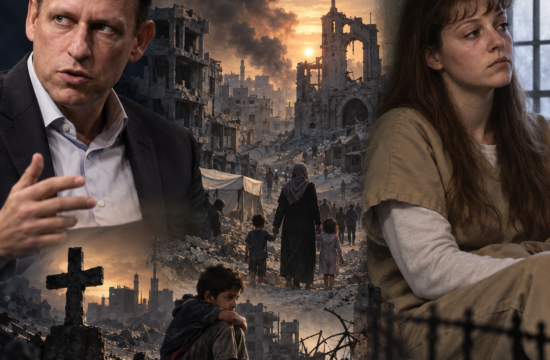
In February 2015, Islamic terrorists kidnapped and murdered twenty-one men on a beach in Libya. Twenty of them were Egyptian Coptic Orthodox Christians. They were ordinary working men who had gone to Libya trying to earn money to support their families.
And then there was the twenty-first man. His name was Matthew Ayariga. He was from Ghana. There are conflicting accounts about how much we know about his Christian background. But what has been consistently remembered is that when his captors questioned him about his faith, and
an easy way for him to leave and save himself, Matthew reportedly looked at the other twenty men and said:
“Their God is my God.”
He knew what that meant.
He knew where those men were going.
And he chose Christ.
Those twenty-one men were later recognized as martyrs by the Coptic Orthodox Church, and in 2023 Pope Francis announced that they would be included in the Roman Martyrology — honored by us as well as witnesses who shed their blood for Jesus Christ. In just a few months the first Catholic parish in the world founded under the patronage of St. Matthew Ayariga is set to open their new Church in Arlington, Texas.
That line from Matthew (now St. Matthew Ayariga) has stayed with me:
“Their God is my God.”
Because think about what that means. Something about the faith of those other men had become visible. Christianity wasn’t simply something they claimed. It wasn’t a label. It wasn’t something they checked off on a form under “religion.”
Even facing death, Jesus Christ was so real to them that another man could look at them and basically say: Whatever they have, I want that. Whoever they belong to, I belong to Him too.
Their God is my God.
Which stops me in my tracks… and makes me wonder, If somebody watched my life, our lives closely… would they ever say that?
Because today Jesus tells us one of the places where our faith becomes most visible. Not when everything is going well. Not when we are sitting in church singing. Not when we post a Scripture verse.
But when somebody hurts us. When we have been betrayed. When somebody actually owes us something.
Peter comes to Jesus today and asks: “Lord, if my brother sins against me, how often must I forgive him? As many as seven times?” You almost have to give Peter credit.
Seven sounds pretty generous. Because most of us start keeping score somewhere around two.
Maybe three if we’re feeling holy. Somebody apologizes once: “It’s okay.” Twice: “All right.”
Three times: “Seriously?”
And eventually we reach the point where we say: “I’m done.” “I gave them enough chances.”
“I will forgive them, but I will never forget.” Which usually means: I have absolutely no intention of forgiving them.
And Jesus answers Peter: Not seven times. Seventy-seven times. In other words: Peter, stop counting. Because forgiveness isn’t supposed to be something Christians ration out until someone hits the limit.
And then Jesus tells this almost ridiculous story.
A servant owes his king an astronomical amount of money — an amount he could never possibly repay. One biblical Scholar explained think of it as someone making $50,000 a year and owes billions of dollars. The king is completely within his rights to demand payment. Instead, the servant falls down and begs for mercy. And the king does something completely unexpected. He forgives the entire debt. Gone. Finished. The servant walks out owing nothing.
And almost immediately he finds another servant who owes him a comparatively tiny amount. He grabs him. He starts choking him. “Pay back what you owe.” And when the man uses almost the exact same words he himself had just used begging the king for mercy… he refuses.
That’s the part that should bother us. Because this servant received mercy… but mercy never changed him. The debt disappeared from the king’s books. But somehow the servant walked out of that room still thinking like a debtor.
Still keeping score. Still calculating. Still demanding payment. He had been forgiven… but he hadn’t allowed forgiveness to penetrate his heart.
And maybe that is what Jesus is asking us today.
Not simply: “Have you forgiven everybody you’re supposed to forgive?” Like God is some divine accountant sending auditors down from heaven to check the books. The deeper question is: What has the mercy of God done to you? Has it changed you? Has the fact that Jesus Christ has forgiven you changed the way you look at everybody else?
Because every Mass we stand before God as people who owe a debt we cannot repay. Every sin forgiven. Every stupid decision. Every selfish choice. Every moment when we knew exactly what God wanted and deliberately chose something else. The things nobody else knows. The things we’re embarrassed even to remember. All of those confessions we’ve made in the Sacrament of Reconciliation and received absolution from all those sins. Extravagant mercy… Again… And again…. And again… And again.
And sometimes we can leave having received all that mercy… and five minutes later somebody cuts us off in the parking lot and apparently that guy cannot be forgiven. That’s us.
Which is why the words from Sirach in the first reading are so direct today: Wrath and anger are hateful things… yet the sinner hugs them tight.
What an image. We hold onto anger. We replay what somebody said. We reread the text. We keep the screenshot. We tell the story again. And again. And again. And every time we tell it, we get angry all over again. Sometimes years later. They may not even be thinking about it anymore. But we are. They hurt us once. And through resentment we allow them to hurt us another hundred times.
And I want to be really clear about something, because sometimes Christians have spoken about forgiveness badly. Forgiveness does not mean pretending something wasn’t wrong. Forgiveness does not mean abuse is acceptable. It does not mean consequences disappear. It does not automatically mean trust is restored. It does not necessarily mean a relationship goes back to what it was before.
And forgiveness is not the same thing as reconciliation. Reconciliation requires something from both people. Forgiveness can begin with just one. Sometimes wisdom requires boundaries. Sometimes justice requires accountability. Sometimes the healthiest thing you can do is say, “I forgive you, but you cannot have the same access to my life that you had before.”
Jesus isn’t asking us to call evil good. He is asking us to refuse to let evil become our master. Because when I refuse to forgive, the person who hurt me can begin occupying a frightening amount of space inside of me. They start controlling my thoughts. My emotions. My relationships. Maybe even the person I am becoming.
And at some point I have to say: You hurt me. But you don’t get to own me.
And that is where today’s second reading from Romans is so powerful: “None of us lives for oneself, and no one dies for oneself.” And then Paul says: “Whether we live or die, we are the Lord’s.” We are the Lord’s. That is our identity.
I don’t belong to my anger. I don’t belong to my resentment. I don’t belong to the person who betrayed me. I don’t belong to what happened to me. I belong to Jesus Christ. And because I belong to Him, I don’t have to let somebody else’s sin turn me into somebody I was never meant to become.
That seems especially important right now.
This week our country marked twenty-five years since the terrorist attacks of September 11, 2001. For many of you, 9/11 is history. You weren’t alive yet. I was 27. I had only been a priest for two years. I remember that day. And I remember the anger afterward. The fear. The grief. The desire for justice. Those emotions were real, and twenty-five years later, for countless families and first responders, the wounds remain real. Nearly 3,000 people were killed in those attacks.
And just the day before that, we marked the one year anniversary of the assassination of Charlie Kirk. A horrific event that shocked the country.
We live in a world where anger is constantly being fed. Someone is always telling you who you should hate. Who destroyed your country. Who ruined your generation. Who is responsible for everything wrong with your life. Left/Right. Boomer/Gen Z. Religious/Atheist. Pick your enemy.
There is an entire culture built around keeping us angry at each other. Because angry people click. Angry people share. Angry people keep watching. Angry people are easy to manipulate.
Jesus offers something radically different. He doesn’t say evil isn’t real. Look at the Cross. Christianity has never said evil isn’t real. We worship a Savior who was betrayed by a friend, abandoned by His closest followers, falsely accused, mocked, beaten, tortured and nailed to a cross.
Jesus knows what injustice looks like.
And hanging there, He doesn’t pretend what they’re doing is okay. He says: “Father, forgive them.” That is not weakness. That may be the strongest sentence ever spoken by a human being.
Because Jesus refuses to let the hatred directed at Him create hatred within Him. That’s what Jesus means by forgiveness and expects from his followers. And maybe some of us aren’t there yet. (Most of us?)
Maybe there is a name that came into your head during this homily. Maybe even hearing the word “forgive” makes something tighten inside you. Okay. You may not be able to walk out of Mass today and suddenly feel differently. Forgiveness is often not a feeling. Sometimes it begins as a decision you have to make over and over: “Jesus, I don’t know how to forgive this person. I don’t even know if I want to forgive them. But I don’t want this hatred anymore. I give this person to You. I give what they did to You. I give my desire to make them pay to You. Handle the justice. Heal what they damaged. And don’t let what they did destroy who You created me to be.”
Maybe tomorrow you have to pray it again. And Tuesday. And Wednesday. Maybe the Seventy-seven times isn’t about 77 different occasions or experiences. Maybe the one is so bad it’s the one that comes up 77 times.
Jesus isn’t keeping count. That’s the point. Because eventually we can stop counting too. And that’s why what happens here at Mass matters so much. In a few moments we come to this altar. And what do we receive?
The Body of the One who forgave His executioners. The Blood poured out, as Jesus tells us, for the forgiveness of sins. We don’t simply come here to admire mercy. We consume it. We receive Mercy Himself. And then He sends us back out there. Into our friendships. Our families.
Our dorms. Our workplaces. Our relationships. Our social media feeds. Our arguments. Our wounds.
And the world gets to see whether what happened at this altar actually changed us.
Which brings me back to Matthew Ayariga.
“Their God is my God.”
Imagine someone looking at your life and saying that. Not because you’re perfect. Not because nobody ever hurts you. Not because you never get angry. But because when you have every reason to hate… you don’t. When everybody expects revenge… you choose mercy. When everybody else is keeping score… you put the scorecard down. When somebody wounds you…
you refuse to become the wound.
And someone watching you starts wondering: What does this person have that I don’t? Maybe that is evangelization in its purest form. Someone sees the way you live… and eventually sees Who you belong to. And says: Their God is my God.
The world already knows how to keep score. The world already knows how to hate. The world already knows how to demand that somebody pay.
What it desperately needs to see are men and women who have been so overwhelmed by the mercy of Jesus Christ that mercy has actually changed them.
Because we do not belong to our anger. We do not belong to our wounds. We do not belong to our past. As Saint Paul tells us: We are the Lord’s. And if we really belong to Him…then let the world see what our God is like.