What does it mean to hope? We use that word all the time. Someone finds a job opportunity that seems perfect, applies, gets an interview, and says, “I really hope I get it.” A loved one goes into the hospital for a medical procedure, and we anxiously wait for news, hoping everything is going to be okay. A student hasn’t cracked a book all semester, has a major exam tomorrow, and says, “Well, I hope I pass.” That last one might be less about hope and more about delusion – but we get the point. We often use the word hope to describe something we want to happen. Something we’re wishing for. Something we’re trying to be optimistic about, even when we’re not particularly confident it will work out.
Thank you for taking the time to read this homily for the 32nd Sunday in Ordinary Time — November 8, 2026
I’m always grateful for those who return each week, and if something speaks to you,
please share these reflections with friends, family members, and others through social media.
Follow Fr. Jim Chern’s Homilies on Apple Podcasts so the new homily is waiting for you every Sunday HERE or on SoundCloud HERE
Thank you for being part of this ministry and for helping these homilies reach far beyond the place where they are first preached.. Sincerely in Christ -Father Jim
This past week, I was reading something by the Catholic philosopher Peter Kreeft that reminded me about how differently our Catholic faith understands hope. Because Christian hope isn’t simply optimism. It’s not wishful thinking. It’s not convincing ourselves that somehow everything is going to work out the way we want. Christian hope is rooted in the promises of God. And that distinction becomes incredibly important when we hear St. Paul say in today’s second reading: We do not want you to be unaware, brothers and sisters, about those who have fallen asleep, so that you may not grieve like the rest, who have no hope.
Paul is talking about one of the most painful experiences any of us will ever endure – death – about losing people we love. And he’s saying Christians grieve differently. Notice he doesn’t say Christians don’t grieve. Jesus Himself wept at the tomb of His friend Lazarus. We’re not supposed to pretend death doesn’t hurt or that faith somehow makes the pain of loss disappear. But Paul tells us we don’t grieve without hope. Why? Because our hope isn’t based on the possibility that something good might happen. It’s based on something that already has happened. Jesus Christ has risen from the dead. And because of that, everything changes. We believe that death doesn’t have the final word. That this life isn’t all there is. That we were created for eternal life with God.
Paul says it beautifully: Thus we shall always be with the Lord. Always. With the Lord. That’s our ultimate hope.
Not that every difficulty in this life will disappear. Not that we’ll always get what we want. Not that everything will unfold according to our plans. But that God is faithful to His promises, and that through Jesus Christ, eternal life is possible.
Which raises a question: If that’s really what we’re hoping for, shouldn’t it change the way we’re living right now?
I have to admit, as I was praying with these readings, I found myself thinking back to a period in my own life that I’ve not spoken about very often. About twenty years ago, after seven years of priesthood, I was pretty convinced I was done. There had been frustrations, disappointments, discouragements. Different things had happened that left me questioning whether I wanted to continue as a priest.
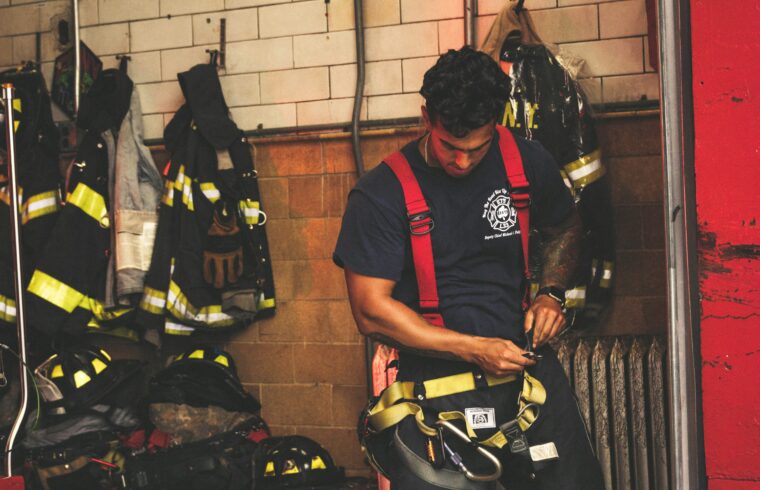
And I didn’t just have some vague idea about leaving. I had a whole other life planned. I was going to become a New York City firefighter. In fact, I had been accepted as a recruit by the FDNY. Now, if you’re not familiar with that process, it’s incredibly competitive. Tens of thousands of people apply, and only a fraction are accepted. And without certain advantages in the selection process, I knew I needed to do exceptionally well on both the written and physical tests. Basically having to have perfect scores in both.
So I prepared. I studied. I trained. Hours upon hours. Days, weeks, months of work. I was determined to make this happen. And I did. On a list of over 18,000 I came in at #2363.
But here’s something that almost nobody knew at the time. While I was putting all this energy into preparing for that future, my prayer life had practically disappeared. Looking back, I can see the warning signs started much earlier.
I remember seeing the advertisement for the firefighter examination in the newspaper back in 2002 or 2003. And I actually cut it out and saved it. Which, looking back now, was a pretty significant moment. I had already made promises. I had already made a commitment to God and His Church. Why was I even entertaining this? And don’t misunderstand me. There’s absolutely nothing wrong with becoming a firefighter. It’s an incredibly noble calling, one that I still have tremendous respect for. But for me, that little newspaper clipping represented something much deeper. My heart was already starting to look elsewhere. And instead of bringing my frustrations, disappointments, and questions honestly to God, I was increasingly trying to figure everything out on my own.
Eventually, I took a leave from priestly ministry. And I got to the point where I was ready to sign the final paperwork to begin training as a probationary firefighter at the Fire Academy on Randall’s Island in New York. Everything was lined up. This was what I’d been working toward for so long.
And I remember sitting in my parents kitchen 20 years ago, ready to sign those papers, when something happened that I still find difficult to explain. I felt what I can only describe as a gentle tug on my arm. Almost as if something – or Someone – was holding me back. And you might think I immediately recognizes that as a beautiful moment of grace. No -not at all. I got angry. I was frustrated. I didn’t want to be interrupted. I’d already made my decision.
So I dismissed it, figuring I’d just sign the papers later.
Not long after that, my family experienced a serious crisis. And that crisis literally brought me to my knees in prayer in a way I hadn’t been for quite some time. I don’t believe God caused that crisis to teach me a lesson. But I do believe He met me in it. And as I began praying again, I had this profound sense of the Lord lovingly speaking into everything that was happening. But also asking me something that, to this day, I can almost hear: “So now that we’re talking again, can we maybe talk about some other things too?”
And that’s where things began to change. Not overnight. It took months of prayer, reflection, and honestly confronting some things I hadn’t wanted to face. Months to recognize how much my discouragement had clouded my judgment. How I had allowed my frustrations to take over. How much energy I’d poured into building another future while neglecting my relationship with God. And perhaps most importantly, how I had confused what I wanted with what God was asking of me.
I share all of that because it helps me hear today’s Gospel in a very different way. Jesus tells this strange parable about ten bridesmaids waiting for the arrival of a bridegroom. Five are wise. Five are foolish. All ten are invited to the wedding. All ten have lamps. All ten know the bridegroom is coming. But only five bring enough oil. And when the bridegroom finally arrives, the others discover that their lamps are going out. They ask the wise bridesmaids to share their oil, and they refuse. Which seems kind of surprising, doesn’t it? We’re used to Jesus telling us to share what we have, to be generous, to help those in need.
But He doesn’t criticize the five wise bridesmaids. Because this parable isn’t really about sharing oil. It’s about something that can’t simply be borrowed from somebody else.
And here’s a detail that’s easy to miss. When the bridegroom is delayed, all ten bridesmaids fall asleep, even the wise ones. The difference isn’t that five are perfect and the others aren’t…. They all grow tired. They all have to wait. But five had prepared themselves for a wait that might be longer and more difficult than they anticipated. They had what they needed to endure. And that oil represents something essential in our own lives: Our relationship with Jesus Christ. A life of grace. A faith that’s actually being lived, cultivated, and strengthened.
The Catholic Scripture scholar Dr. John Bergsma offers a beautiful insight here. He asks, how do we keep replenishing that oil — the oil of the Holy Spirit — in our lives? Through three things: faith, prayer, and the sacraments. And here’s the thing: we need all three working together. Faith can’t simply remain something we believe in our heads. It needs to lead us into conversation with God through prayer, and into a real encounter with Him through the sacraments. Prayer without faith can become empty words. Receiving the sacraments without cultivating faith and prayer can become something we simply go through the motions of. And faith and prayer aren’t meant to be separated from the sacraments, where Christ so generously pours His grace into our lives. Bergsma compares these three to a cord woven together from three strands – each strengthening the others. And through them, the Holy Spirit continues to produce His fruits in our lives, especially love and joy, which we desperately need when life becomes difficult, when the waiting seems endless, when things don’t go according to plan.
That’s how we keep our lamps burning. Not by relying on a burst of religious enthusiasm or assuming that yesterday’s faith will somehow carry us through tomorrow. But by continually allowing God to replenish what’s running low.
And that’s something I had to learn the hard way. I hadn’t stopped believing in God. I hadn’t forgotten what I had been taught. I was still a priest. But I’d neglected one of those essential strands — prayer. And without even realizing it, I’d allowed my spiritual reserves to run dangerously low.
And here’s what’s unsettling about that. It’s possible for any of us to be incredibly disciplined, successful, and prepared for everything the world tells us matters – while neglecting the one relationship that gives all of it its ultimate meaning.
Because there will be moments when our plans fall apart. When we’re disappointed. When somebody we love dies. When life doesn’t turn out the way we hoped. And that’s when we discover whether our hope is rooted simply in the outcomes we wanted – or in the God who remains faithful even when those outcomes don’t happen.
That’s what makes Jesus’ final words in the parable so haunting. When the five foolish bridesmaids finally arrive, they find the door locked. They cry out, “Lord, Lord, open the door for us!” And the bridegroom answers: Amen, I say to you, I do not know you. Notice He doesn’t say, “You didn’t know enough about me.” He says, “I do not know you.” It’s about relationship.
And there’s something frightening about realizing that we can become so caught up in everything else that we neglect the very One we’re supposed to be preparing to meet. But here’s where our first reading from Wisdom offers something incredibly beautiful – and hopeful. Wisdom isn’t simply described as something we’re supposed to go searching for. Wisdom is actually searching for us. Going out to meet those who desire her.
In other words, God isn’t sitting somewhere far away, waiting for us to figure everything out on our own. He’s already coming toward us. He’s already offering us His grace. He’s already trying to get our attention. Sometimes even through what feels like the gentlest tug on an arm. The question is whether we’re listening.
And that’s where all three readings come together. St. Paul reminds us of our ultimate hope — eternal life with Christ. Jesus challenges us to prepare our hearts for Him now. And Wisdom reassures us that we don’t do that alone. God is already seeking us, inviting us, offering us the grace we need. Not someday. Not when life settles down. Not after we’ve accomplished everything else on our list. Now.
And not because we’re terrified of being caught unprepared. But because we genuinely believe that the One we’re preparing to meet is the One who loves us more than anyone else ever could.
Looking back on that chapter of my life, I’m struck by the patience of God. Even when I wasn’t particularly interested in talking to Him, He hadn’t stopped loving me. Even when I was determined to go in another direction, He hadn’t given up on me. And when I finally found myself on my knees again, He didn’t begin by condemning me for having wandered so far.
He invited me to begin talking with Him again. And to listen. That’s the God we place our hope in. Not a God who guarantees that every one of our plans will succeed. But a God who has promised us something greater than anything we could ever plan for ourselves: Eternal life with Him.
And maybe that’s why, after all these years, I still remember so clearly what I sensed the Lord saying to me in prayer. Because I don’t think He was asking that question just of me. Maybe He’s asking each of us, in whatever circumstances we find ourselves today: “Now that we’re talking again, can we maybe talk about some other things too?”