A few years back, a story out of Russia made international headlines. It’s the kind of story that sticks with you—not just because it’s bizarre, but because it’s heartbreaking. A woman named Fagilyu Mukhametzyanov, age 49, was declared dead by her doctors. Her family gathered for her funeral. Friends came to pay their respects. Prayers, tears, and sorrow filled the room. And then, in the middle of the service, she suddenly woke up.
Thank you for taking the time to read this homily for CORPUS CHRISTI – THE SOLEMNITY OF THE MOST HOLY BODY AND BLOOD OF JESUS CHRIST -JUNE 7, 2026 – Your support means a great deal to me, and I’m deeply grateful for the many who share these messages with their friends, families and social media followers. If you’ve found meaning in these words, I’d be grateful if you’d share them with others who might benefit.
And for those who prefer listening, you can find the audio version on SoundCloud HERE or subscribe to the podcast on iTunes HERE. Your comments, messages, and the way you’ve embraced these homilies continue to inspire me. Sincerely in Christ -Father Jim
Imagine what that must have felt like. She was lying in her coffin, surrounded by people mourning her “death,” and suddenly she realized where she was. She screamed. The family rushed her to the hospital. But she only lived another twelve minutes.
Her husband later told reporters, “Her eyes fluttered and we immediately rushed her back, but she only lived another twelve minutes.”
Most of us will never go through something that dramatic. But there’s a lesson in that story, and it’s a lesson about belief.
What we believe shapes how we live. Our choices, our priorities, our relationships, even our destiny—they all flow from what we think is true. People act on what they believe, for better or for worse.
And on this Solemnity of Corpus Christi—the Feast of the Most Holy Body and Blood of Christ—we’re confronted with a belief so astonishing, so radical, that if we really accept it, it should change everything.
Remembering the Desert
In our first reading from Deuteronomy, Moses reminds the Israelites of their forty years wandering in the desert. Not four days. Not four months. Forty years of hunger, uncertainty, and waiting. And then Moses says something surprising—God allowed them to be hungry before He fed them with manna. Why? Because God was teaching them something they’d never forget:
“Not by bread alone does one live, but by every word that comes forth from the mouth of the Lord.”
There is a hunger that goes deeper than physical hunger. And if we’re honest, we know what that feels like.
We live in one of the wealthiest societies in history. More food, more entertainment, more technology, more possessions than anyone before us. And yet—anxiety is rising. Loneliness is rising. Depression is rising. Addiction is rising. We’re well-fed, but we’re starving.
Starving for meaning. Starving for purpose. For forgiveness. For love. For hope. For God.
Deep down, every human heart has a hunger nothing in this world can fill. Not money, not success, not relationships, not achievement, not vacations, not possessions, not social media. Nothing. Because that hunger was placed there by God Himself.
The Bread of Life
That’s why today’s Gospel matters so much. Jesus doesn’t offer advice or a philosophy or a self-help program. He gives us Himself.
He says, plainly:
“I am the living bread that came down from heaven; whoever eats this bread will live forever; and the bread that I will give is my flesh for the life of the world.”
The crowd is shocked. They argue. It sounds outrageous. But notice—Jesus doesn’t back down. He doesn’t soften His words. He doesn’t say, “Wait, you misunderstood me.” He doubles down:
“Whoever eats my flesh and drinks my blood has eternal life, and I will raise him on the last day. For my flesh is true food, and my blood is true drink.”
And Saint Paul, in our second reading, says it just as clearly:
“The cup of blessing that we bless, is it not a participation in the blood of Christ? The bread that we break, is it not a participation in the body of Christ?”
For two thousand years, the Church has believed exactly what Jesus said. Not because it’s easy. Not because it’s symbolic. But because it’s true.
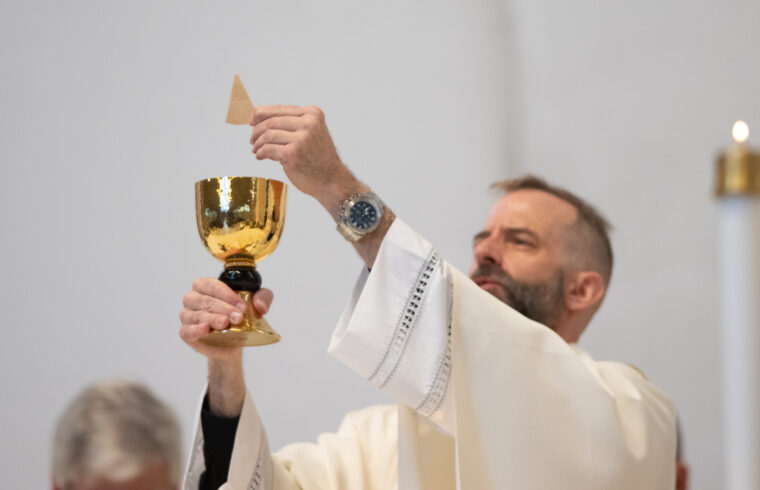
At every Mass, the bread and wine become the Body, Blood, Soul, and Divinity of Jesus Christ. Not a symbol. Not a reminder. Not simply a sacred meal. Jesus Himself.
The same Jesus born in Bethlehem. The same Jesus who walked Galilee. Who healed the sick. Who died on Calvary. Who rose from the dead. Who sits at the right hand of the Father.
That Jesus is here. Right now. Really. Truly. Substantially.
Do We Really Believe?
But if we’re honest, many Catholics live as if this isn’t true. We see it in empty pews. In the casual way people sometimes approach Communion. In how quickly people rush out after Mass. In lives that look just like everyone else’s.
We say “Amen” when the Host is held before us. But do we mean it? Do we believe we’re receiving the living God?
The other day, a visitor to our Newman Center noticed me stop to genuflect as we passed by the chapel. She smiled and said it reminded her of when she went to Catholic school. But I couldn’t help but notice she didn’t genuflect herself. I didn’t say anything at the time—and honestly, I wouldn’t have thought twice about it if she hadn’t brought it up. But it struck me: for her, that simple gesture of reverence for the Eucharist, for Christ living in our midst, had become nostalgia. Something remembered, not something lived.
I do believe. I didn’t become a priest for a symbol. I promised obedience, celibacy, simplicity, and prayer because I believe Jesus Christ is truly present on this altar. I believe He changes lives, forgives sins, heals hearts, feeds souls—and is worth giving everything for.
That same conviction transformed the life of a teenager named Carlo Acutis. Some of you know his story. Growing up in Milan, Carlo was surprised by how many Catholics—including his own family—treated the Eucharist as ordinary. So he researched Eucharistic miracles, built a website to share them, and often said: “The Eucharist is my highway to heaven.”
When he was diagnosed with leukemia, he offered his suffering for the Pope and for the Church. Before dying at fifteen, he said, “I am happy to die because I have lived my life without wasting even a minute on things that do not please God.”
Carlo understood something many adults never learn: The Eucharist is not something. The Eucharist is Someone—a Person who loves us, waits for us, desires to unite Himself to us, and wants to transform us.
Saint Augustine once told the newly baptized: “Become what you receive.” That’s the goal. Not just to receive Christ, but to become Christ for others. To become His hands, His voice, His compassion, His mercy, His presence.
The Power of Belief
Thinking about that story I told at the beginning about the woman in Russia. The tragedy wasn’t just a medical mistake (as awful as that obviously was). The tragedy was that everyone in the room was acting on what they believed to be true. Because that’s what belief does—it shapes how we live.
So here’s the question: If someone watched your life for a month—without hearing a single word—would they conclude you really believe Jesus Christ is present in the Eucharist? Would they see someone eager for Mass, who prays, who receives Communion with reverence, whose life has been changed by an encounter with the living God? Or would they see someone for whom the Eucharist is just a symbol?
Every tabernacle in every Catholic church is a burning bush. Every Mass is Bethlehem, Calvary, and Easter morning made present. Every Host on this altar is Jesus Christ saying again: “Take and eat.”
The greatest tragedy isn’t mistaking a living person for someone dead. The greatest tragedy would be standing in the presence of the living God and never recognizing Him.
Today, Jesus Christ is here. Not symbolically. Not metaphorically. Not emotionally. Really. Truly. Substantially.
Come to Him with faith. Come to Him with hunger. Come to Him with love. And then go forth, and become what you receive.
For whoever eats this Bread will live forever. Amen.