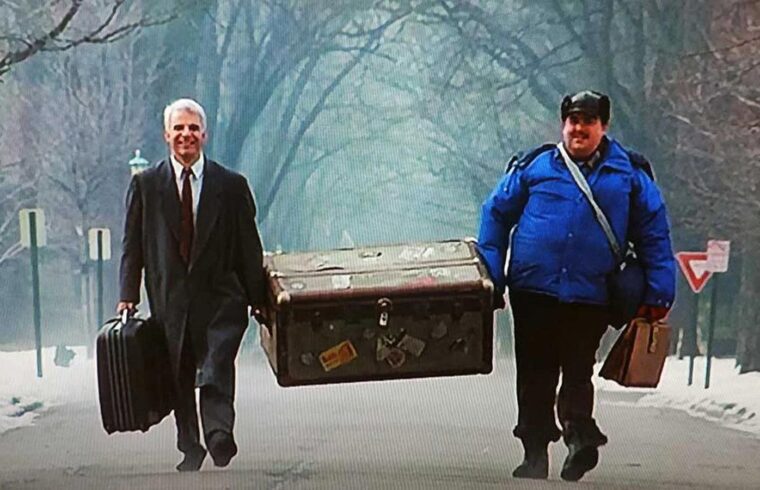
With Thanksgiving, we officially enter the holiday season – although, for some people, apparently that started sometime back in October. But I digress. For most of us, the next several weeks will be filled with all sorts of beloved traditions. Some that we’ve practiced for generations, others that we’ve picked up along the way. One somewhat unusual tradition I have is that every Thanksgiving Eve, a group of priest friends and I get together to watch the classic comedy Planes, Trains and Automobiles. It’s a movie I still remember seeing when it first came out in theaters back in 1987, which is somewhat disturbing to realize was almost forty years ago.
HAPPY THANKSGIVING! Thank you for taking the time to read this homily for Thanksgiving Day – November 26, 2026
I’m always grateful for those who return each week, and if something speaks to you,
please share these reflections with friends, family members, and others through social media.
Follow Fr. Jim Chern’s Homilies on Apple Podcasts so the new homily is waiting for you every Sunday HERE or on SoundCloud HERE
Thank you for being part of this ministry and for helping these homilies reach far beyond the place where they are first preached.. Sincerely in Christ -Father Jim
There are countless hilarious scenes, one of my favorites involves Steve Martin at a rental car counter, where his frustration with yet another obstacle to getting home finally boils over. There’s a particular word he uses with such reckless abandon that it pretty much single-handedly earned the movie its “R” rating. Obviously, I won’t be quoting that scene here at Mass. But anyone who’s seen the movie knows exactly what I’m talking about.
Yet what’s interesting about that movie is that, for all the comedy and ridiculous situations, there’s something genuinely beautiful underneath it all. Steve Martin’s character, Neal, is desperately trying to get home to his family for Thanksgiving. And he’s convinced that the biggest obstacle standing in his way is this incredibly annoying, endlessly talkative stranger, Del, played by John Candy.
But by the end of the movie, Neal discovers something he had completely overlooked. While he’s been consumed with trying to get home to the people he loves, the man who’s been driving him crazy has no home or family waiting for him. And suddenly, everything looks different. The person he had spent so much time trying to get away from becomes someone he wants to welcome into his home.
And I think there’s something about that which speaks to what Thanksgiving is really supposed to be about. Because sometimes we can become so focused on what we’re doing, what we want, or even what we’ve been blessed with, that we miss something much more important.
That’s what seems to happen in today’s Gospel.
Ten men suffering from leprosy cry out to Jesus for mercy. Leprosy meant more than a terrible disease. It meant isolation from family, friends, and society. Their lives had essentially been taken away from them. And Jesus gives them those lives back. As they go to show themselves to the priests, they’re healed. All ten of them.
Imagine their excitement. They could go home, embrace their families, return to the lives they’d been missing. So what happened to the other nine? We tend to assume they were simply ungrateful. But maybe they were so overwhelmed by what had happened that they couldn’t wait to get home. Whatever the reason, they kept going.
Only one turned around. And Luke makes a point of telling us that he was a Samaritan, someone considered an outsider, and the one many would have least expected to respond this way.
Yet he was the one who returned, fell at Jesus’ feet, and thanked Him. Jesus asks, “Ten were cleansed, were they not? Where are the other nine?” And then tells the Samaritan, “Stand up and go; your faith has saved you.” All ten received the gift of healing. But only one stopped long enough to recognize the Giver.
And isn’t that the challenge of Thanksgiving? Certainly, we have an extraordinary amount to be grateful for. As Americans, we’re blessed with a beautiful country, remarkable freedoms, and opportunities that many around the world can only dream of. We’re grateful for those who serve and protect our nation, particularly those who are far from their families today. And we’re blessed by the richness of so many different cultures, backgrounds, and traditions that have contributed to the nation we call home.
Our country isn’t perfect. Our history has its share of struggles and failures. But that doesn’t diminish the blessings we have received or our responsibility to preserve and share them. In fact, when George Washington proclaimed a national day of Thanksgiving in 1789, he called upon Americans to acknowledge the providence of Almighty God and to offer thanks with grateful hearts. It was a recognition that our blessings aren’t simply the result of our own accomplishments. That there is a God whose goodness and providence sustain us.
And that’s something we can easily forget. We become so accustomed to the people, opportunities, and blessings in our lives that we begin to take them for granted. Sometimes we don’t recognize just how precious they are until something happens that threatens to take them away.
Which is why Thanksgiving can also be a difficult day for some. While many will gather around tables filled with laughter and loved ones, others will be painfully aware of an empty chair. Some are struggling with illness, financial worries, or relationships that have become strained or broken. And those experiences remind us of something important. Christian gratitude doesn’t mean pretending everything in life is wonderful. It means recognizing that even when everything isn’t wonderful, God has not abandoned us.
That’s why this Gospel is perfect for today. Those ten lepers didn’t encounter Jesus when everything was going well. They encountered Him in their suffering. And one of them discovered that the greatest gift wasn’t simply having his old life restored. It was discovering the Lord who had given him new life.
Which brings us to something particularly beautiful about our being here this morning. Because before all the meals, celebrations, traveling, and everything else this day holds, we’ve done what that Samaritan did. We’ve come back to Jesus. And the very heart of our Catholic worship, the word Eucharist, literally translated from Greek means thanksgiving. Here, we recognize the greatest gift of all: Jesus Christ Himself, who gives us not just blessings in this life, but the promise of eternal life.
So as we celebrate today, perhaps we can take a moment to recognize someone we’ve taken for granted. To be attentive to someone who’s struggling. To remember that the blessings we’ve received aren’t simply ours to enjoy, but gifts we’re called to share. Because one of the best ways to thank God for His blessings is to become a blessing to someone else.
And maybe that’s why, after all these years, I still love watching that movie every Thanksgiving. It reminds me that sometimes the greatest blessings aren’t necessarily the things we’ve been desperately trying to get. Sometimes they’re the people, the moments, and the presence of God that have been right in front of us all along.
Ten men were healed. Only one came back. And this Thanksgiving morning, we’ve come back too. Not because everything in our lives is perfect, but because we know the One who has been with us through it all.
And perhaps the simplest, most meaningful prayer we can offer today is the one that Samaritan expressed by falling at Jesus’ feet: “Lord, thank You.”
Happy Thanksgiving.