

Some names are so tightly connected to what they do they almost become synonymous with those pursuits. You hear Gordon Ramsay, and you immediately think of food — celebrity chef, restaurants, cooking competitions, and usually someone being loudly informed that their risotto is terrible and the food is raw. You hear Elon Musk, and you think of technology, innovation, electric cars, rockets, and space exploration. And when you hear the name Mike Rowe, most people think of Dirty Jobs.
Thank you for taking the time to read this homily for the 19th Sunday in Ordinary Time — August 9, 2026. I’m always grateful for those who return each week, and especially for those who share these reflections with friends, family members, and others through social media. If something here speaks to you, I’d be grateful if you would pass it along to someone who might need to hear it as well.
And for those who prefer listening, you can find the audio version on SoundCloud HERE or subscribe to the podcast on iTunes HERE.
Your comments, messages, encouragement, and continued support mean more than you know. Thank you for being part of this ministry and for helping these homilies reach far beyond the place where they are first preached.. Sincerely in Christ -Father Jim
For years, Mike Rowe traveled around the country showing viewers what it is really like to do some of the most difficult, unpleasant, dangerous, and occasionally disgusting jobs imaginable. He has worked alongside sewer inspectors, roadkill collectors, and people who recycle leftover food from casinos – which was every bit as revolting as it sounds. We will leave it there. Those who need more information can find it on Google after Mass. Unlike much of reality television, Dirty Jobs was not built around fake drama. It showed us the people we rarely notice doing jobs most of us would never want to do.
But one of Mike Rowe’s most provocative ideas did not come from a particular episode. It was a philosophy he’s named and spoken about on numerous occasions over the years. A concept, he calls “Safety Third.” That phrase immediately sounds irresponsible. Safety third? Shouldn’t safety always come first?
Rowe explained that throughout his years filming dangerous jobs, safety professionals repeatedly told him, “Your safety is our number-one priority.” And then, moments later, they would ask him to climb a suspension bridge, test a shark suit, descend into a mine, or wash windows on a skyscraper.
His point was not that safety does not matter. But that safety cannot always be the highest value in every situation. Because a life devoted entirely to avoiding risk would not really be much of a life.
To illustrate his point, he reminds us that driving carries risk. Flying carries risk. Construction, farming, travel, relationships, and raising a family all carry risk. We take reasonable precautions. We wear seat belts. We follow laws. We use protective equipment. We try not to do foolish things. But we also recognize that there are some things more important than simply keeping ourselves comfortable, protected, and untouched.
That raises an uncomfortable question for us as Christians: How many of us have become risk-averse when it comes to our faith?
We want God to protect us. Shield us. Prevent strife and tension. Make our families safe. Keep us from being embarrassed, rejected, hurt, disappointed, or misunderstood.
To be sure, there is nothing wrong with praying for protection. We ask God to deliver us from evil and grant us peace. But sometimes we begin to assume that if we are faithful enough, prayerful enough, and good enough, God will guarantee us a life without storms. We begin to think that God’s job is to make sure nothing frightening ever happens to us.
Then we hear today’s readings. And they show us two men who trusted God, put themselves on the line, and reached a point where they thought they might die.
The first reading gives us one of the most beautiful scenes in the Old Testament. Elijah stands on the mountain waiting for the Lord. After God is not found in the powerful wind, earthquake or fire, its when there’s a “tiny whispering sound” that Elijah covers his face because he recognizes the presence of God.
It is a beautiful reminder for those moments when we are looking for some dramatic sign from heaven. When we want God to make things obvious. We want the voice to thunder. We want the door to fly open. We want the answer to appear in giant letters. We pray, “Lord, just tell me what You want me to do.” And then we become frustrated because there is no earthquake, no fire, and no voice booming from the clouds.
But God cannot be manipulated. We cannot dictate how He will answer us. Sometimes He comes in the dramatic moment. More often, He comes in silence. In a thought that will not leave us alone. In a Scripture passage that suddenly feels as though it was written directly for us. In a conversation with someone we trust. In the quiet conviction that there is something we need to do, something we need to stop doing, someone we need to forgive, or some step we need to take.
But to appreciate this whole scene, and how we got here, we need to remember why Elijah is hiding in a cave. He is not enjoying a peaceful spiritual retreat. He is a fugitive. Just before this passage, Elijah had participated in one of the most dramatic confrontations in the entire Bible. The people of Israel had abandoned the Lord and turned toward the false pagan god Baal, encouraged by Queen Jezebel.
Elijah challenged 450 prophets of Baal to a public showdown. They would prepare a sacrifice but light no fire. The prophets would call upon Baal. Elijah would call upon the Lord. The God who answered would be shown to be the true God. For hours, the prophets of Baal shouted, danced, and pleaded. And of course, nothing happened… because there is no other God, but the Lord God.
Then Elijah prayed. And fire came down from heaven so instantly and dramatically. It was an overwhelming victory. The people fell to the ground and cried out, “The Lord is God!” You might think that after something like that, Elijah’s troubles would be over.
Instead, Queen Jezebel didn’t take this humiliation too well. She made it clear she wanted Elijah to be killed.
Elijah had risked everything for God. He had stood alone against hundreds of false prophets.
He had remained faithful when almost everyone else had compromised. And his reward was a death threat. So Elijah ran. He collapsed under a tree and prayed, “Enough, Lord. Take my life.” The prophet who had just stood fearlessly before 450 enemies was now exhausted, frightened, discouraged, and ready to give up.
And God did not shame him. God gave him food. God gave him rest. God led him to the mountain. And God met him in the silence. The whisper was not God telling Elijah, “Nothing bad will ever happen to you again.” It was God telling him, “You are not alone. I am still here. And your work is not finished.” Elijah discovered that faithfulness does not guarantee a life without fear. Faithfulness means discovering that God is present even when we are afraid.
The same truth appears in today’s Gospel. The disciples are out on the Sea of Galilee in the middle of the night. The wind is against them. The waves are battering the boat. They are exhausted, frightened, and far from land. And notice: they are in that storm because Jesus told them to get into the boat. They are not there because they disobeyed Him. They are not outside God’s will. They are in the storm precisely because they followed Jesus’ instructions.
That challenges one of our assumptions about faith. We often assume that if we are doing what God wants, everything should go smoothly. The relationship should work. The ministry should succeed. The prayer should be answered quickly. The opportunity should open. The people we love should appreciate everything we do.
But sometimes obedience leads directly into a storm. Not because God has abandoned us. Not because we chose incorrectly. Sometimes the storm is part of the journey.
In the darkness, the disciples see someone walking toward them on the water. They are terrified. They think it is a ghost. But Jesus calls out: “Take courage, it is I; do not be afraid.”
Peter responds in a way that is either incredibly courageous or slightly insane. “Lord, if it is You, command me to come to You on the water.” And Jesus says one word: “Come.”
Peter has a choice. He can remain in the boat. The boat is being battered by waves, but at least it is familiar. Or Peter can trust that the voice of Jesus is more reliable than everything his senses are telling him. Peter gets out. For a few astonishing moments, Peter does the impossible. He walks on water.
We remember what happens next. Peter notices the wind, becomes frightened, begins to sink, and cries out, “Lord, save me!” And Jesus immediately reaches out His hand and catches him. People sometimes speak about Peter as though he were a complete failure. “Look at Peter. He lost his faith. He sank.”
Yes, he sank. But there were eleven other disciples in that boat who never got out. Peter may have had imperfect faith. But at least he had enough faith to put his foot over the side. The problem was not that Peter took a risk. Jesus had commanded him to come. His problem began when he took his eyes off Jesus and focused entirely on the wind. As long as Peter looked at Christ, he was able to do what he could never have done by himself. When he stared at the storm, fear took over. And even then, Peter knew what to pray: “Lord, save me!” Not an eloquent prayer. Not a carefully composed prayer. Three words. “Lord, save me!” And Jesus immediately stretched out His hand.
He did not let Peter sink for a while to teach him a lesson. He did not say, “You got yourself into this. Figure it out.” He reached out and caught him.
That is the Gospel. Faith does not mean we will never become afraid. Faith does not mean we will never lose our focus. Faith does not mean we will never feel ourselves sinking. Faith means knowing whose name to call when we do. It means believing that even when our grip on Jesus becomes weak, His grip on us remains strong. Jesus is not encouraging recklessness. Peter did not jump out of the boat because he wanted attention. He stepped out because Jesus said, “Come.”
That is the difference between faith and foolishness. Foolishness says, “I will do whatever I want, and God will rescue me.”
Faith says, “Because Jesus is calling me, I will obey – even when obedience frightens me.” The issue is not whether something feels safe. The issue is whether Jesus is calling us.
Sometimes He calls us to have a conversation we have been avoiding.
To apologize when we would rather defend ourselves.
To forgive someone who has deeply hurt us.
To admit that we need help.
To go to Confession after years away.
To end something that is pulling us away from God.
To consider the priesthood or religious life.
To speak openly about our faith when others may mock us.
To serve people who cannot repay us.
To give more generously than feels convenient.
To trust Him with a future we cannot control.
Each time, we face the same choice Peter faced. Do I stay in the boat because it is familiar? Or do I trust the One who says, “Come”? Christianity was never built by people who made personal safety their highest goal.
The Blessed Virgin Mary risked her reputation when she said, “Let it be done to me.”
St. Joseph risked his plans when he took Mary into his home.
The apostles risked their lives when they left everything to follow Jesus.
Saint Paul risked imprisonment and death to preach the Gospel.
And at the center of our faith is not a God who remained safely in heaven. At the center of our faith is Jesus Christ, who entered the storm of human sin, suffering, and death. He did not save us from a distance. He stepped into our world. He stretched out His hands on the Cross. And He entered death itself so that He could raise us with Him.
So perhaps the Christian response to “Safety Third” is something even more direct:
Christ first.
Faith first.
Obedience first.
Not because safety is meaningless.
Not because we should seek out danger.
But because there are things worse than being uncomfortable.
There are things worse than being rejected. There are things worse than failing. One of them is spending our entire lives safely inside the boat while Jesus stands on the water saying, “Come.”
Some of us are facing storms right now. Some are waiting for a diagnosis. Some are struggling with a relationship. Some are worried about a child, a spouse, or a parent. Some feel like Elijah—exhausted, discouraged, and wondering whether anything they have done has made a difference. Some feel like Peter—trying to follow Jesus but overwhelmed by the wind.
The Lord may not remove the storm immediately. He may not come in the earthquake, the fire, or the dramatic answer we expected. He may come in a whisper: “I am here.” “Do not be afraid.” “Come.”
Perhaps today, the Lord is asking us to stop demanding that He make everything safe before we trust Him. Perhaps He is asking us to stop waiting until we feel completely ready, confident, and unafraid.
Peter was not ready.
Elijah was not fearless.
Paul was not protected from heartbreak.
But God worked through all of them.
The question is not, “Will there be wind?” There will be wind.
The question is not, “Will I ever become afraid?” At some point, we all will.
The question is: when the wind rises and we begin to sink, where will we look? At the storm? At everything that might go wrong?
Or at Jesus?
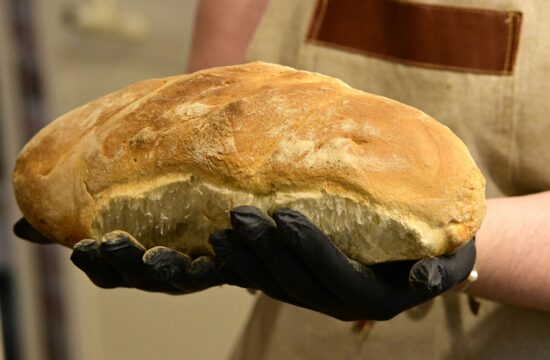
In a few moments, the same Jesus who walked across the water comes to us in the Eucharist. Quietly. Without thunder. Without earthquake. Without fire. In the humblest of appearances in the most simplest of bread, in a simple host. A whispering presence.
But it is truly Him. The One who says, “Take courage.” The One who says, “Do not be afraid.” The One who says, “Come.” We are not receiving a guarantee that life will be easy. We are receiving something far greater. We are receiving the Lord who will enter every storm with us. The Lord who will find us in every cave. The Lord who will catch us whenever we cry out.
So let us not ask God merely to keep us safely inside the boat. Let us ask Him for the faith to hear His voice above the wind. The courage to step where He calls us. And the humility to cry out when we begin to sink: “Lord, save me.”
Because the Christian life is not about never facing a storm. It is about discovering that even in the storm, Jesus is there. And wherever Jesus is calling us – that is the safest place we can ever be.





Excellent, reading this gives me a great understanding of our faith in Jesus