There’s a line in today’s first reading from Exodus that’s just heartbreaking: “Is the Lord in our midst or not?” Just let that hang in the air for a minute. This is coming from people who had watched the ten plagues devastate Egypt. Who had walked through the Red Sea on dry ground. Who saw the world’s most powerful empire collapse before their eyes.
God didn’t just show up for them—He made it unmistakably clear that the idols and false gods of Egypt were empty. They saw it. They lived it. And yet, at the first sign of real trouble—just a little thirst in the desert—everything unravels. Their faith starts leaking out. The complaints get louder. The anger builds, until Moses is genuinely afraid for his life: “These people are almost ready to stone me.”
Thank you for taking the time to read this homily for THIRD SUNDAY OF LENT – MARCH 8, 2026 – Your support means a great deal to me, and I’m deeply grateful for the many who share these messages with their friends, families and social media followers. If you’ve found meaning in these words, I’d be grateful if you’d share them with others who might benefit.
And for those who prefer listening, you can find the audio version on SoundCloud HERE or subscribe to the podcast on iTunes HERE. Your comments, messages, and the way you’ve embraced these homilies continue to inspire me. Sincerely in Christ -Father Jim
To be fair. There’s nothing sinful about being thirsty. Or scared. Or anxious or discouraged. Those are just facts of being human. That’s not the problem.
The problem is what they did with those feelings—or maybe more honestly, what they didn’t do.
Instead of turning to God, they turned on Moses.
Instead of praying, they grumbled.
Instead of remembering what God had done, they fed their fear.
And that fear, left unchecked, led them to ask: “Is the Lord in our midst or not?” It’s a devastating question—not because God had abandoned them, but because they’d lost sight of Him.
We see the same thing play out in the Gospel today. It’s understandable that our focus goes to the Woman at the Well—her messy story, her broken relationships, her complicated past. But notice something simple about the scene: she comes to the well carrying a water jar.
That jar represents the reason she came.
The thing she thinks she needs.
The problem she’s trying to solve that day.
But her story is bigger than just her. She stands in for all of Samaria.
The Samaritans were descended from the same people we just heard about in Exodus. Centuries later, their spiritual confusion had only deepened. By this point in history, their land had been invaded, their culture torn apart, their people scattered. They still believed in the God of Israel—but their faith was distorted, tangled up with discouragement and doubt. They worshipped, but on their own terms, not God’s.
And again, the real issue isn’t the suffering or the setbacks. It’s what they did—or didn’t do—with them.
That’s a tension I know pretty well.
About twenty years ago, I almost left the priesthood. It was messy, complicated—a time when I was angry, disillusioned, discouraged… and did I mention angry? Really angry. I was convinced I was finished. I had my exit plan. I thought I was done.
Right in the middle of that mess, my family got the kind of phone call that stops your life in its tracks. Someone in my family—someone close—went to the doctor for what we all thought was just a virus or a cold. Suddenly, literally within minutes and hours it was blood tests, specialists, hospital transfers, and words like “life-threatening” and “aggressive disease.” It wiped me out. It wiped out my family.
But in that bleak moment, something happened that hadn’t happened in a long time: I prayed. Not the polished, formal kind of prayer. Not the “here’s what I think I should say” kind of prayer. Just raw, desperate honesty—standing alone in a hospital parking garage, pouring my heart out.
And in that moment, I felt peace. Real peace. The sense that God was there… knowing that He was listening. And believing that somehow, some way, we’d make it through. Which thanks be to God, we did. My family member’s recovery, months later, was nothing short of miraculous.
But the bigger and somewhat unexpected miracle was that something changed in me. I kept praying. It was as if Jesus was saying, “Now that we’re talking again… maybe we can talk about some of the other stuff too.”
That’s exactly what happens at the well in today’s Gospel—which is what triggered that memory for me. Jesus starts so simply: “Give me a drink.” The woman tries to keep things on the surface. She changes the subject. She debates theology. But Jesus gently leads her deeper.
Not to embarrass her.
Not to shame her.
But to heal her.
And then He says something extraordinary: “Whoever drinks the water I shall give will never thirst.” Every one of us is thirsty in ways that have nothing to do with water.
We thirst for love.
We thirst for meaning.
We thirst for peace.
We thirst for purpose.
And we try to quench that thirst with all sorts of things—relationships, achievements, distractions, comfort, approval… even endless scrolling and constant noise. But none of it lasts. None of it is enough.
That’s the tragedy in Exodus: the Israelites forgot where real satisfaction comes from. They turned inward instead of upward. Fear got louder than memory. And eventually they asked the devastating question: “Is the Lord in our midst or not?”
The miracle in the Gospel is that the woman finally turns toward Jesus. And the moment she does, everything changes. John tells us something that sounds like a small detail, but it’s actually huge: She leaves her water jar behind. Think about that. The very reason she came to the well in the first place… the long journey, at the worst time of the day, that she goes alone so she doesn’t have to deal with anyone or anything – the water, the jar that had been the whole reason for her visit – she forgets it.
Because suddenly she’s found something more important than water. She runs back into town telling people she had been avoiding, “Come see a man who told me everything I’ve ever done.” The woman who came to the well burdened by shame becomes the one bringing an entire town to Christ. All because she finally stopped avoiding the conversation. She let Jesus into her real life.
Lent asks each of us to face that same question from the desert: “Is the Lord in our midst or not?”
Not as an accusation.
But as an invitation.
Because the truth is—He is in our midst.
Right here.
In this, His Word.
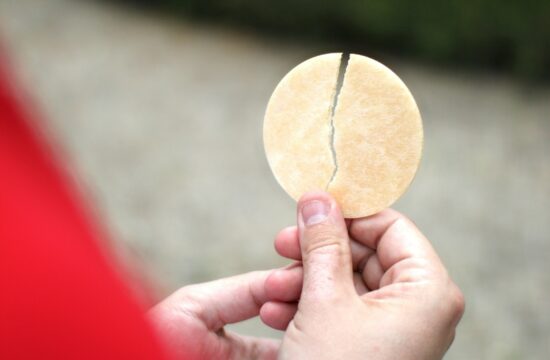
In the His Body, Blood, Soul and Divinity that we receive in the Eucharist.
But also in those quiet moments when we finally get honest in prayer.
The real question isn’t whether God is present.
The real question is whether we’ll do what the Israelites struggled to do… and what the woman at the well finally did.
Turn toward Him.
Because when you finally meet Christ at the well,
you discover something surprising:
the thing you came for isn’t the thing you needed.