
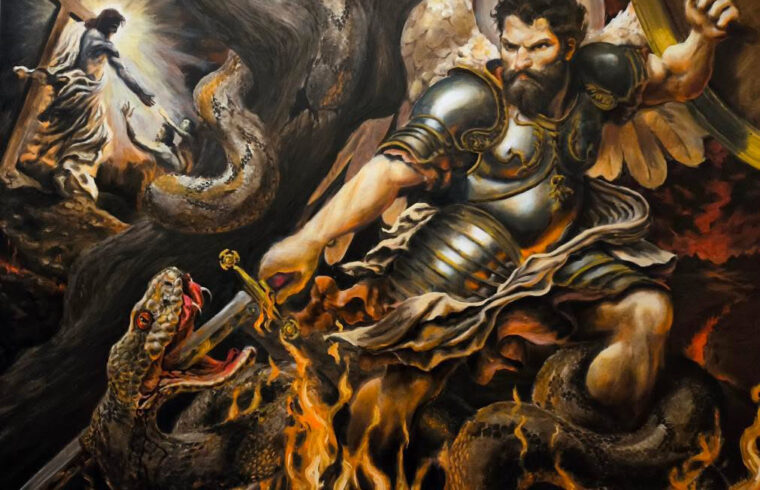
You’ve probably heard the warning “Don’t dance with the devil.” But the problem starts long before the dance. It starts when you agree to the conversation. The devil usually doesn’t kick in the door, he prefers to pull up a chair. He doesn’t always look like a serpent or snake. The disguises change. The voice doesn’t. It shows up when you’re tired, or stressed, or maybe a little too proud of yourself. And before you know it, you’re not just hearing it you’re having a full conversation with it.
It’s the voice that asks “Is it really that big of a deal? Did God really say that? Everyone else is doing it… No one will ever know… You deserve this.” That’s the voice.
Thank you for taking the time to read this homily for FIRST SUNDAY OF LENT – February 22, 2026 – Your support means a great deal to me, and I’m deeply grateful for the many who share these messages with their friends, families and social media followers. If you’ve found meaning in these words, I’d be grateful if you’d share them with others who might benefit.
And for those who prefer listening, you can find the audio version on SoundCloud HERE or subscribe to the podcast on iTunes HERE. Your comments, messages, and the way you’ve embraced these homilies continue to inspire me. Sincerely in Christ -Father Jim
Every year on the first Sunday of Lent, we’re dropped right into this ancient spiritual showdown. We will always hear a Gospels account of Jesus being hungry, isolated and facing satan in the desert. The temptations are not random or even surprising (which shouldn’t be surprising, satan is not able to create he can only distort) They’re eerily familiar – the temptation to take the easy way out (turn these stones into bread) the urge to prove yourself – (Jump and let the angels catch you) and that itch to become all powerful and popular (all these kingdoms can be yours). The temptations are all about ways we can shortcut life, chase what looks good, make ourselves the main character… But this battle didn’t start in the desert. It started in a garden.
In the first reading from Genesis we hear God has created this breathtakingly beautiful creation. Creates Adam and Eve and gifts them with everything they could possibly need or want. There’s not 10 commandments yet, it’s one rule – don’t eat from the tree of the knowledge of good and evil. That’s it. The rest is fair game – just this one rule for them to follow.
The serpent doesn’t show up with fangs, fireworks or dramatic music. He’s so subtle, sly and sneaky. With just one question – “Did God really say you can’t eat from any tree in the garden?” Notice what he does – he’s twisted God’s love and generosity into restriction. God had said you may eat from EVERY tree – except one – the evil one reframes it “So God won’t let you eat from any tree…” He plants suspicion. He’s making it sound like God is stingy, and even worse unfair.
Eve knows the truth. In fact she corrects him “No we can eat from the trees – just not that one or we’ll die.” Here’s where Eve made the critical mistake. Before taking the fruit – it was talking with the devil at all, it was that she kept the conversation going. And before too long, she is entertaining the doubts, letting the suspicion take root. Adam, has always been held with the greater responsibility here. He wasn’t there protecting Eve or the garden. He let the serpent slither in, he doesn’t speak the truth that he knew to save him and his wife from this horrific mistake but instead he decides to join in.
That’s temptation’s playbook: No grand leaps into sin, just gradual slides. The devil doesn’t kick down doors; he pulls up a chair, whispers compromises. From Eden to now, we drift: “Is it really that bad? Does it matter?”
Fast forward to the Gospel, Jesus in the desert. Right before this, Jesus had been baptized by John. The heavens had opened and the voice of God the Father echoes “This is my beloved son.” Immediately, the Spirit drives Him to the desert. Forty days no food, nothing but wild animals, heat and silence. And the serpent, shows up “If you are the Son of God…” Do you hear it? In the garden: “God is holding out on you.” In the desert: “Are you really who God says you are?” The tempter always assaults identity and then proposes compromises – stones into bread; JUMP and force God’s hand; take power without the cross.
Jesus doesn’t fall for it. He doesn’t get into a debate. He doesn’t argue or reason or try to prove Himself. He simply stands on the truth “IT IS WRITTEN” – He answers with God’s word. He refuses to have a conversation with the devil.
I wish I could say that I always do that. In fact I was kind of surprised remembering an incredibly embarrassing story of one of my dumbest nights of my college career that I’ve never shared from the pulpit as I was reflecting on Eve’s conversation with the devil.
It was spring of my sophomore year. Life was going pretty great. I had been rehired as a Resident Advisor which meant for a second year in a row I was getting a major discount on my room and board. Even more exciting to me, after a grueling primary and then general election I had been elected Class President for the coming year. I was feeling pretty good about myself. A little too good. I wasn’t a wild child by any stretch of the imagination. I’d barely had a drink of alcohol in high school or college – mostly because I hated the taste – and hated the idea of getting caught or in trouble even more. But with all my “successes” I was starting to believe my own hype. A few friends had suggested “Let’s celebrate – your entitled to cut loose a little.” I said no at first – I had too much to lose, my RA job, my reputation. “Come on you deserve it” – Again I say no, did I want to get impeached before I even got inaugurated as Class President. But the idea kept coming back – “Come on, we’ll be careful. Just a small group. We’ll get a couple motel rooms and be away from campus, no one will drive, it will be contained. “No one will find out – no one will know.” It’s amazing how quickly “absolutely not” becomes “well… maybe.” Someone decided we’d make it a costume party – dress as your favorite professor – because apparently if you add irony to bad decisions, it makes them smarter. Someone else offered to buy the drinks since they were actually of legal age. All the “what ifs” got smoothed away. It started to sound safe. Reasonable even.
So there we were at the motel by 7PM. We have barely opened one beer each when there’s a knock on the door. Four police officers. Four. My friend in a panic whispers to me- “should we run?” Run where, excatly? Through the police? Genius…. Here’s the kicker. One of my friends dressed as a campus priest (collar and all) and was the designated driver. He speaks up to the officers apologizing, promising he hadn’t drank at all (and was willing to take a breathalyzer) and would make sure we got out of there without any incidents. In the anxiety and panic of the moment, he didn’t even remember he was dressed as a priest as one of the cops said “You shouldn’t be encouraging this.” They confiscated the drinks, gave us a warning, told us if they came back we were leaving with them. Party over.
I remember thinking as we got back to campus… I knew this was wrong before we got there. I knew it when I said yes. I knew it when I rationalized it. The fall didn’t start at the motel. It started with the conversation. I share this not because I am proud of it – at all – it was one of the most humiliating and embarrassing nights of my young adult life, that thank God wasn’t far worse. I share it because I think it’s more universal than we imagine.
We’re not robbing banks or committing some headline grabbing sin. Our battles are usually quieter, sneakier. We justify texts we shouldn’t send, sites we shouldn’t click, gossip we repeat. We negotiate shortcuts at work or school, the “I deserve this splurge.” We rationalize nursing resentments, numbing stress with unhealthy habits and destractions. Quiet battles and sneaky voices asking: “Did God really say…?” The devil doesn’t need dramatic, he just needs dialogue.
St. Paul in his letter to the Romans tells us – through one man, sin entered the world. Adam failed at the tree. But through one man, grace overflows. Jesus is victorious at a tree. One stretched out his hand and brought death into the world. One stretched out His arms on the cross and defeated death, restores life eternal. So this isn’t about becoming nicer people, or marginal improvements. It’s God’s rescue mission. And what the garden and the desert both remind us is that temptation always attacks our identity. YOU WILL BE LIKE GODS – IF YOU ARE THE SON OF GOD. But before Jesus ever healed of fed anyone, preached a word, before He even carried the cross – He was already beloved. And at our baptisms that same truth was spoken. We are God’s beloved sons and daughters – not when we get our acts together; not when we conquer that habit; not when we impress God with whatever way we come up with. Now. It’s often said the devil loves to remind us of our sins, but God loves to remind us of our identity.
That’s why we need this season of Lent. It’s not our annual participation in some suffering Olympics where we try to prove how strong or disciplined we can be. It’s about remembering who we are – and whose we are. It’s about remembering our identities as God’s beloved sons and daughters. And stepping out into the desert with Christ to learn from Him. Learning how to recognize that voice sooner. To slam the door before the conversation gets comfortable. While at the same time following Christ and His example. When we hear those lies, those evil whispers to answer like Jesus does “It is written…” and speak words of truth – I am beloved; I belong to Him; I don’t need this.
As we are now a few days into Lent, here’s a good opening point to reflect on: Where are you still talking with the devil, letting the conversation linger? Where are you rationalizing, negotiating, or trying to make a deal with something you know, deep down, isn’t part of God’s best for you?
This week, don’t just look for the big, dramatic temptations. Watch for the subtle ones—the quiet voices that say, “No one will know. You deserve this. It’s not a big deal.” And when you hear them, remember: you don’t have to answer. You don’t have to explain yourself. You don’t have to prove anything.
You are already beloved. Not because of your success, your discipline, or your failure. Before you did a thing, God already spoke your name and called you His own. That’s the truth that holds in the desert and in the moments you feel weakest. That’s the truth the devil can’t stand.
So this Lent, don’t just give something up—give up the conversation. Refuse to negotiate with the lies. When you hear that voice, answer with the words of Christ: “It is written. I am beloved. I belong to God. I don’t need this.”
When you stumble, when you fall, don’t run and hide. Come back to the Father, who is always waiting, always ready to remind you who you are. And maybe for some of us, that means making a good confession—maybe even for the first time in a long time. There is no better way to slam the door on the serpent and silence those old lies than to hear Jesus, through the Church, speak words of forgiveness and mercy right to your heart. Don’t let shame or fear hold you back. The confessional isn’t a place of judgment—it’s where we remember who we really are: beloved, chosen, and free.
This is not a season of shame. It’s a season to reclaim your identity, to be set free from the old stories and start living in the truth. So let’s step into the desert together—not alone, but with Christ. Let’s ask for the grace to recognize the serpent’s voice sooner, to shut down the conversation, and to walk out of the desert more convinced than ever: I am loved. I am chosen. I am His.
Let’s stop talking to snakes.
Let’s start listening to the voice that calls us beloved.









I feel like the Lord sent this homily for me with perfect timing.