Every January 1st, we walk through the church doors with a strange mix of feelings. On one side, there’s a cautious hope—the kind that comes with flipping to a new page, stretching out a blank calendar, and the faint promise that this year, maybe, will be different. But for a lot of us, hope isn’t the only thing tagging along this morning. There’s also the exhaustion—a quiet, worn-out ache that’s settled into our bones after another year of world events, bad headlines, disappointments, and that lingering sense that being a good person just doesn’t come as easily as it used to.
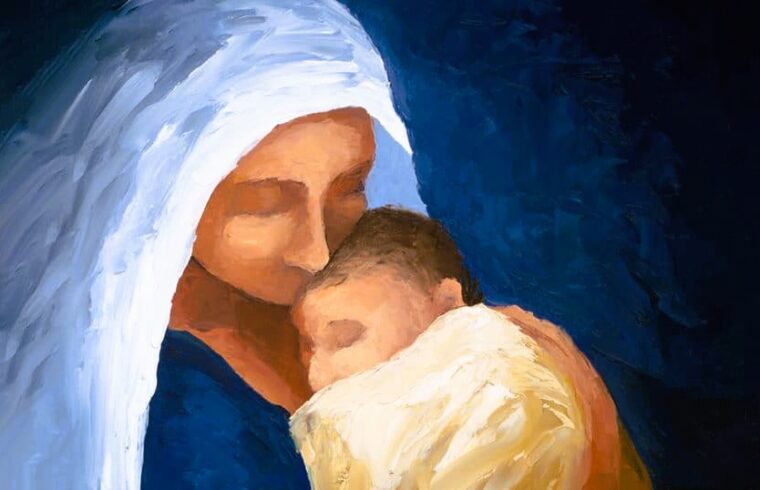
And in that tension—between hope and heaviness—what does the Church offer us on this first day of the year? Not a list of resolutions. Not a call to hustle harder. Not a moral pep talk. Instead, the Church gives us a mother. A woman holding a child. A simple, silent scene tucked into the rough edges of Bethlehem—God, gently handed into the arms of Mary.
MERRY CHRISTMAS! Thank you for taking the time to read this homily for THE FEAST OF MARY THE MOTHER OF GOD- January 1, 2026 – Your support means a great deal to me, and I’m deeply grateful for the many who share these messages with their friends, families and social media followers. If you’ve found meaning in these words, I’d be grateful if you’d share them with others who might benefit.
And for those who prefer listening, you can find the audio version on SoundCloud HERE or subscribe to the podcast on iTunes HERE. Your comments, messages, and the way you’ve embraced these homilies continue to inspire me. Sincerely in Christ -Father Jim
A couple nights ago, as I was closing out 2025, a priest friend texted me: “You need to see this movie, Fatman.” Now, I’ll admit, the name threw me. The trailer made it look like a dark comedy—a little tongue-in-cheek, a bit Bad Santa. What it turned out to be was unexpectedly grim, at times almost like a Santa Claus version of a revenge film—not what you expect for Christmas, right? It was violent. Bleak. From start to finish, it left me unsettled.
But what kept bothering me long after it ended is that it wasn’t really about Santa Claus at all. Underneath all the chaos, it was wrestling with this question: what happens when someone who’s supposed to represent goodness, someone who keeps giving, starts to see that the world doesn’t care much about goodness anymore? What happens when goodness gets tired?
That’s not just a movie plot; it’s a real question. And when I sat down with today’s Gospel—the shepherds braving that midnight dash to Bethlehem, huddled around a newborn, hearts pounding with wonder—suddenly, I could see the connection. They come running, full of excitement, marvel at the child, and then… they go. They return to their routines; life picks up, as it always does. And isn’t that just how it happens for us, too? We have glimpses—moments when God is close, when hope flickers—but before we know it, we’re swept back into the noise and the worry of daily life.
But then Luke slips in a sentence that quietly changes everything: “Mary treasured all these things and pondered them in her heart.” Everyone else moves on, but Mary stays. She takes it all in—the joy, the confusion, the uncertainty—she receives it, holds it, lets it sink deep.
Mary never asks, “Will anyone say thank you? Will this child be loved? Will goodness win in the end?” She doesn’t demand answers or guarantees. She doesn’t try to calculate, or bargain with God, or run through all the possible “what ifs” that might steal her peace. She simply accepts what’s given. She welcomes Christ. Eight days later, she’s there again, quietly witnessing Jesus enter the covenant of his people. She knows this path will cost her—she knows the story will break her heart—but still, she says yes.
That’s not a shallow, naive faith. That’s a faith with scars. That’s a faith that says, “Even if it’s hard, even if nobody notices, even if goodness feels misunderstood and alone, I won’t walk away.” That’s a mother’s faith.
In that movie, the thing that troubles us is that goodness is battered and bruised; it doubts; it wonders if the effort is still worth it. And maybe that’s more honest than we like to admit. Because God doesn’t barge into the world to impose goodness by force, or magic. He invites. He trusts us to receive Him and carry His light, just as Mary did.
Mary can’t control the world, can’t keep Jesus from every wound or disappointment, can’t shield Him from the cost of love. All she can do is be faithful—today, in this moment—and trust that’s enough.
Most people aren’t rejecting goodness; they’re just weary from carrying it alone. Mary models a different way: presence that doesn’t flinch. She stands by the manger, she will one day stand by the cross, and she stands by the Church now—not because the world has somehow earned Christ, but because Jesus has come to rescue us when we could not rescue ourselves. He enters the world not simply to inspire us, but to save us—from sin, from death, from every darkness we cannot overcome alone.
We live in a world that wants blessings without self-gift. Mercy without change. Joy without sacrifice. And more than ever, it’s easy to feel tired of shouldering the weight of goodness when so few seem interested in sharing it. That’s when we need Mary. She stands in the middle of joy and pain, faith and fear, refusing to check out or grow hard. She stays.
At the start of this year, the Church isn’t asking us to fix the whole world overnight. She’s asking us to stay faithful. To keep Christ present, quietly, in our homes and habits. To keep carrying goodness—even when it’s misunderstood, even when it stings, even when it goes unseen. To trust that wounded goodness, faithful goodness, is the kind that changes the world.
Mary, Mother of God, shows us: when the world is tired of being good, don’t walk away. Stay. Hold Christ again in your heart. Say yes—again and again.
Because even when goodness feels tired, even when it costs us, it still matters. And through it, God still finds a way to be born among us.