
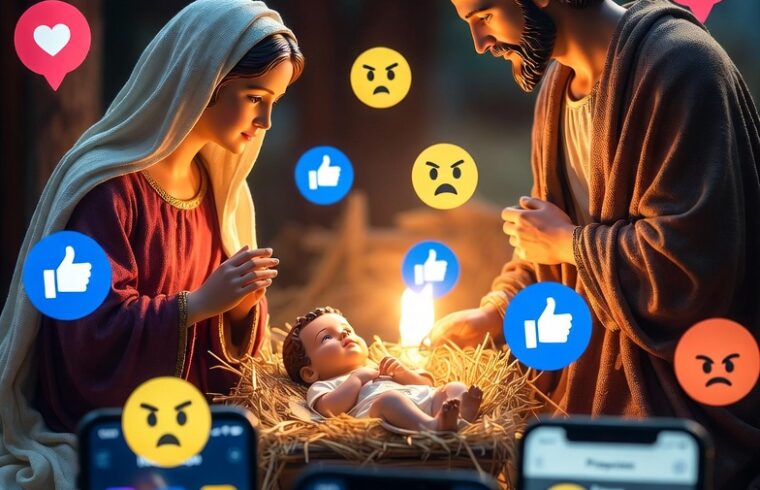
Every December, the same tensions seem to surface—just with new packaging.
We see controversies over neighborhoods and homeowners’ associations arguing about Christmas lights: how bright they can be, how long they can stay up, whether they’re allowed at all. Something meant to express joy suddenly becomes a rule violation.
We watch nativity scenes pulled into cultural and political arguments—not simply debated as religious symbols, but sometimes repurposed to make statements that go far beyond the Gospel itself. In those moments, the manger stops being an invitation to contemplate the mystery of God-with-us and becomes a prop in someone else’s argument.
MERRY CHRISTMAS! Thank you for taking the time to read this homily for THE FEAST OF THE HOLY FAMILY – December 28, 2025 – Your support means a great deal to me, and I’m deeply grateful for the many who share these messages with their friends, families and social media followers. If you’ve found meaning in these words, I’d be grateful if you’d share them with others who might benefit.
And for those who prefer listening, you can find the audio version on SoundCloud HERE or subscribe to the podcast on iTunes HERE. Your comments, messages, and the way you’ve embraced these homilies continue to inspire me. Sincerely in Christ -Father Jim
Even artificial intelligence joined the mix this year. AI-generated Christmas posts went viral and sparked online scuffles—arguments about faith, inclusion, and intent. A computer-generated greeting somehow became evidence that Christmas is either under attack or being manipulated.
And of course, social media amplifies everything.
A simple “Merry Christmas” becomes a viral battle.
“Happy Holidays” is framed as either thoughtful or hostile.
Comment sections turn into places where no one is really listening—only reacting.
Then there are the atheist campaigns.
This year, a Times Square billboard declared, “Jesus is Palestinian.” Like earlier slogans such as “Skip Church” or “Who needs Christ in Christmas?”, it wasn’t offered as an invitation to reflection, but as a provocation—designed to unsettle believers during the very season when Christians celebrate God entering the world.
Taken together, these moments reveal something important.
Because here’s the truth: we don’t spend this much time and energy on things that truly don’t matter to us.
If something is irrelevant, we scroll past it.
We ignore it.
We don’t feel threatened by it.
So why Jesus?
Why does a child in a manger—of all things—still stir discomfort, resistance, and sometimes hostility?
The answer is the same today as it was two thousand years ago.
Because Jesus doesn’t just inspire.
He disrupts.
He challenges the illusion that we are fully in control.
He unsettles the belief that success, power, or self-definition will save us.
He threatens the idea that we can build a meaningful life without surrender, sacrifice, or love.
And that’s uncomfortable—especially in a culture that prizes autonomy above everything else.
Which is why today’s Gospel feels so jarring.
Here we are just a few days into the Christmas season, still surrounded by these beautiful Christmas decorations… singing carols about peace on earth. And suddenly this Gospel from Matthew drops us into fear, violence, and flight.
The imposter King, Herod hears about the birth of the true king of the Jews, Jesus — and he panics.
Not because this child has an army.
Not because He has influence.
But because Herod senses what this baby represents: a power he cannot control.
So Herod chooses fear over trust.
Control over humility.
Self-preservation over love.
And innocent people suffer. He orders the murder of every boy under the age of two. Something so revolting its shocking that so many remain indifferent in our day and age when it still happens with abortion…but I digress.
Joseph is warned in a dream, and he does the only thing he can do.
He takes Mary and Jesus and flees to Egypt.
The Holy Family becomes displaced.
They leave their home under threat of violence.
They travel into a foreign land.
They depend on God’s providence and the mercy of others to survive.
Not as a political statement.
Not as a slogan.
But as a concrete human experience of uncertainty, vulnerability, and trust.
And this is where we need to be careful.
Scripture doesn’t tell us this so we can turn the Holy Family into a modern political analogy—whether to support or condemn any policy, party, or leader.
Matthew isn’t giving us a blueprint for contemporary politics.
He’s revealing the heart of God.
God enters the world not shielded by power, but exposed to danger.
Not protected by influence, but entrusted to love.
Not imposing control, but surrendering to human vulnerability.
Which brings us back to that phrase: “Jesus is Palestinian.”
It’s true that Jesus was born in the Middle East. He was a Jewish child living under Roman occupation. He didn’t look like the figures on most Christmas cards. But the problem comes when the Holy Family is reduced to a talking point—flattened into a meme meant to score points or provoke outrage.
Because when people invoke that phrase, they often skip the part of the Gospel that makes everyone uncomfortable:
that God enters the world without choosing sides, without endorsing an agenda, and without granting us control over Him.
The Holy Family refuses to be claimed by any ideology.
Herod isn’t condemned because he’s on the “wrong side of history.” He’s condemned because fear and the hunger for power, for control made him violent.
And Mary and Joseph aren’t holy because they fit an agenda—but because they trusted God when clarity, safety, and control were stripped away. By allowing themselves to enter into that incredibly vulnerable place where God’s providence isn’t a nice ideal or theory but their only hope, the only thing they can trust – and in that, they welcome Jesus into their hearts, their lives, this new home they create… where Jesus becomes the central figure to them. It’s in their yielding to Jesus that they become the Holy Family.
When we turn the Holy Family into a symbol to win arguments—online or otherwise—we miss the Gospel entirely.
Because the real question isn’t, How do we use Jesus to support what we already believe?
The real question is: What does Jesus ask of us—especially when it costs us something?
That’s where today’s second reading comes in.
Saint Paul doesn’t offer a political program.
He offers a way of life:
Compassion.
Kindness.
Humility.
Gentleness.
Patience.
Bearing with one another.
Forgiving as the Lord has forgiven you.
That kind of life doesn’t go viral.
It doesn’t trend.
But it changes everything.
And this is where the Feast of the Holy Family becomes deeply relevant—especially as the year 2025 is in its final days and a New Year is on the immediate horizon.
Because for many people, family life isn’t neat or ideal.
There are fractured relationships.
Anxiety about the future.
Pressure to succeed.
Fear of commitment.
Fear of failure.
Fear of losing control.
The Holy Family isn’t presented to us as a perfect, pain-free model.
They’re presented as a holy response to uncertainty.
Mary doesn’t understand everything—but she trusts.
Joseph doesn’t have a long-term plan—but he obeys.
Jesus enters the world not with power—but with dependence.
God doesn’t save the world by force.
He saves it by entering fully into human vulnerability.
And that’s what makes Him threatening.
Because love that vulnerable demands a response.
So when people ask—explicitly or implicitly—“Who needs Christ in Christmas?”
The answer isn’t defensive.
It’s honest.
We do.
We need Christ when families are complicated.
We need Christ when the future feels unstable.
We need Christ when control slips through our fingers.
We need Christ when love requires sacrifice.
And if we truly believe that, then the most powerful witness we can offer isn’t outrage or argument.
It’s lives shaped by mercy.
Homes marked by forgiveness.
Relationships rooted in humility and love.
The Holy Family shows us that God doesn’t ask for perfection.
He asks for trust.
He doesn’t demand control.
He invites surrender.
And that child in the manger—still vulnerable, still unsettling, still demanding love—is the greatest gift we will ever receive.
Not just at Christmas.
But every day of our lives.









I’m a little late reading this, but thank you, Father Jim, for these thoughts. People are so busy overthinking things that they forget the simplicity of turning to Jesus!