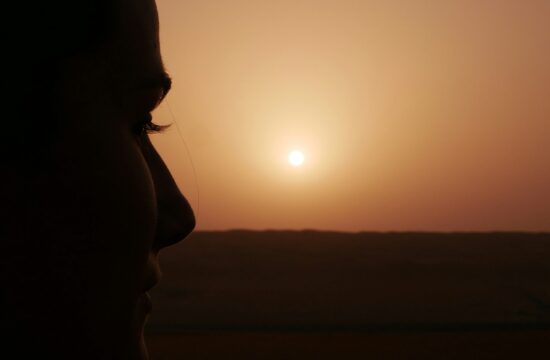
There’s this quiet little phrase that sneaks around our minds more than we realize. It’s like a pop-up ad for the human heart. It shows up at work, in relationships, in prayer, even when we’re just trying to fall asleep:
If only…
If only my boss weren’t impossible, then I’d actually enjoy going to work.
If only this family didn’t argue every Christmas, then maybe we’d finally look like those picture perfect commercials or Hallmark Channel movies.
If only my friends understood me, then I wouldn’t feel like I’m so alone.
We don’t say it out loud, but it’s always there.
And once that little phrase gets in our bloodstream, it multiplies:
If only I scored higher.
If only I looked better in pictures.
If only I’d stop this habit.
If only I had someone in my life or someone else in my life.
If only I got that attention, that affirmation, that raise, that internship…
If only, if only, if only.
And we start to live like the missing piece to our happiness is always one step outside our reach — one achievement, one fix, one person away.
Thank you for taking the time to read this homily for the SECOND SUNDAY OF ADVENT (December 7, 2025). Your support means a great deal to me, and I’m deeply grateful for the many who share these messages with their friends, families and social media followers. If you’ve found meaning in these words, I’d be grateful if you’d share them with others who might benefit.
And for those who prefer listening, you can find the audio version on SoundCloud HERE or subscribe to the podcast on iTunes HERE. Your comments, messages, and the way you’ve embraced these homilies continue to inspire me. Sincerely in Christ -Father Jim
We don’t even notice we’re doing it. It just becomes the soundtrack of our lives.
And then we hear Isaiah in today’s first reading.
And Isaiah doesn’t whisper to our longing — he pours gasoline on it and throws a few duraflame logs on and strikes a match. He paints this wild, breathtaking, and honestly bizarre picture:
A world where wolves nap next to lambs like they’re starring in a Pillow Pet commercial:
A leopard curled up with a young goat.
Bears and cows eating lunch together… peacefully… like they just got seats at Panera.
A toddler reaching into a snake’s hole like it’s no big deal — like, “Look Mom, nature!”
None of this fits in the world we know. It reads like something from a fantasy novel. Or that viral video with a lion and a dog who are somehow best friends.
And we hear it and think: “Okay, Isaiah, that’s adorable, but let’s be serious. That’s not how the world works.” But Isaiah isn’t spinning fairy tales. He’s not doodling a Disney scene. He’s a prophet — which means God is speaking through him with fire.
And Isaiah is saying:
This isn’t fantasy.
This is actually what God intends.
God isn’t dreaming; we are the ones who dream too small.
We imagine survival. God imagines peace.
We imagine coping. God imagines restoration.
We imagine getting through the week. God imagines a whole new creation.
But how do we get to that where that becomes real? The way to that world Isaiah describes doesn’t start with a therapy session, or another self-help book. It starts with a guy in camel hair shouting in the desert.
John the Baptist is… how do I put this kindly… the least polished messenger God has ever hired.
He’s out in the wilderness — not exactly suburban Jerusalem.
He’s eating locusts — which, by the way, are not the proto-keto diet; they are bugs.
He’s wearing camel hair — which is basically a wearable Brillo pad.
He looks like someone who walked directly out of a wilderness survival show and straight into Scripture.
And the best part?
He’s not tucked away somewhere weird.
He’s at the Jordan River — which was the crossroads of the entire region. One scholar said to think of it as the “O’Hare Airport of the ancient world.”
Meaning – everybody passed through the Jordan.
Everybody heard him.
This wasn’t a fringe guy yelling at clouds; this was a man standing right in the flow of human traffic.
And he yells one word that cuts through everything:
“Repent.”
Not “Dream bigger.”
Not “Manifest your destiny.”
Not “Live your truth.”
Not “If only you fix this one thing…”
Just:
Repent.
Turn around.
Change direction.
Let God in — for real.
It’s abrupt.
It’s jarring.
And it’s exactly what we need.
Because the peace we ache for — the world Isaiah describes — doesn’t come from fixing one more thing “out there.”
It begins with letting God work “in here.”
Look closely at that first reading again from Isaiah and you notice something important. God doesn’t eliminate predators. He transforms them.
He doesn’t get rid of wolves — He changes them.
He doesn’t banish the bears — He reorders their instincts.
He doesn’t squash the snake — He removes the venom.
God doesn’t fix the world by removing the difficult things. He fixes the world by transforming them from the inside out.
And that is exactly what repentance is.
Repentance is not:
- shame
- guilt-tripping
- beating yourself up
- pretending you’ve ruined everything
Repentance is letting God have access to the real you.
Repentance says:“God, here’s where I’m weak.”
“Here’s where I keep choosing things I know won’t satisfy.”
“Here’s where I pretend everything’s fine when it isn’t.”
“Here’s where my ‘if only’ is eating me alive.”
And God says, “Finally.
That’s exactly where I want to begin.”
Some of us think repentance is for people who survived a scandal.
No — repentance is for anyone who has a heartbeat and wants peace.
It’s for kids, college students, young professionals, parents, grandparents… and most definitely priests — anybody whose humanity gets messy.
Repentance is choosing honesty over image.
It’s deciding to make peace instead of being right.
It’s letting God interrupt your cynicism.
It’s refusing to numb out when life gets hard.
It’s admitting you’ve tried everything else and none of it worked.
And yes — it includes the confessional line, which is a sacrament designed precisely for people who know they can’t DIY salvation.
John preached at the Jordan because everybody passed through.
And our lives have crossroads too:
Those moments when what we want
and what we’re actually doing
finally crash into each other.
Sometimes softly.
Sometimes dramatically.
Advent itself is a crossroads — a holy collision point.
We light candles not because we’re sentimental, but because we actually believe the darkness is not permanent.
And every time an “if only” rises in your heart — even the small ones — that’s not failure.
That’s the place God wants to work.
That’s the place He wants to transform.
That’s where your wolf and your lamb meet.
Don’t hide the messy places.
They are the places God uses to build the kingdom.
Not your polished places — your real ones.
Not your Instagram-ready angles — your behind-the-scenes footage.
So this Advent, don’t just listen to John the Baptist — let him annoy you a little.
Let him interrupt you.
Let him startle you.
Let him throw cold water on your spiritual autopilot.
Because he’s not shouting:
“Try harder!”
Or “Act nicer!”
Or “Pretend everything’s fine!”
He’s shouting because something is about to happen.
Someone is coming.
Prepare the way of the Lord.
Not the Lord of a perfectly ordered Nativity scene.
Not the Lord of polite holiday spirituality.
But the living God who breaks into real places, messy places, wolf-and-lamb places.
And here’s the stunning part:
Jesus is not waiting for a better version of you.
He is coming to the real you.
The tired you.
The anxious you.
The distracted you.
The “I really should pray more but also I’m binge-watching a show” you.
The you with the list of “if onlys.”
That’s where He wants to begin.
Isaiah’s vision isn’t a fantasy.
It’s a spiritual blueprint.
It’s what happens when God finally gets into the places we keep sealed off.
Wolves calm down.
Lambs stop running.
Fear loses its bite.
Old wounds stop poisoning us.
Places we thought were dead suddenly bloom.
That is what repentance makes possible.
So let this be the Advent —
not where you fix everything…
not where you chase the next “if only”…
but where you hand those “if onlys” to God and say:
“Here.
Start here.
Start in the place I’d rather not admit exists.”
Because the kingdom of God is not far off.
It’s not abstract.
It’s not someday.
It is at hand.
Closer than your next breath.
And if you turn toward Him — even a little —
you may just discover that the life you’ve been chasing…
doesn’t hold a candle to the life He’s been preparing for you.
Repent.
For the kingdom of God is at hand.
And it will be better — infinitely better —
than anything your ‘if only’ could ever dream up.